
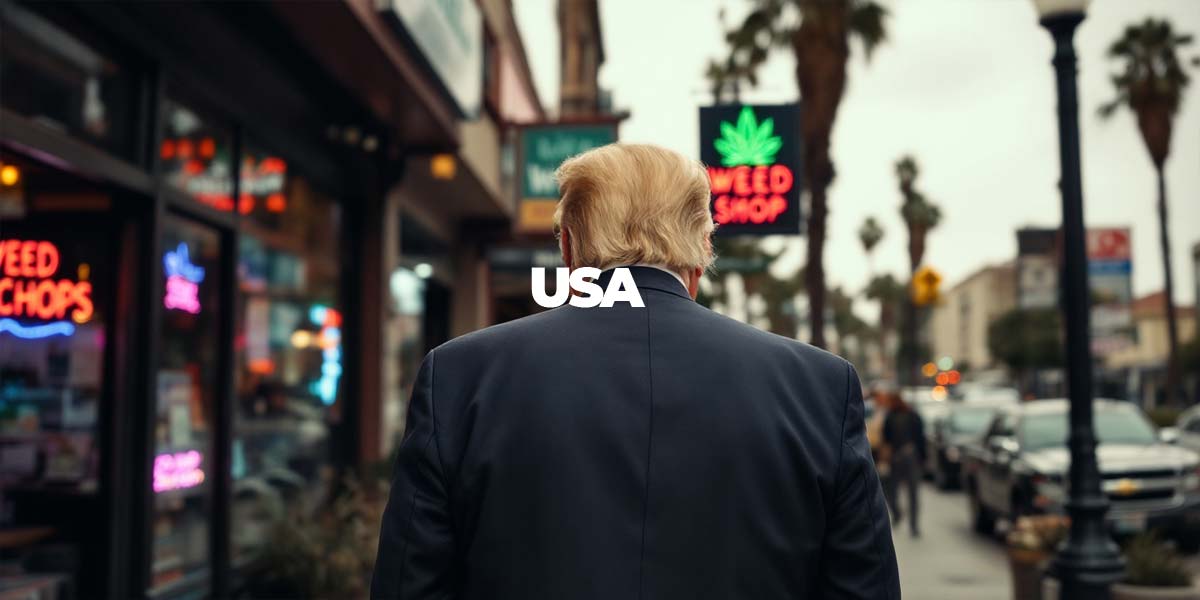
US president plans new cannabis classification – We had just discussed this very topic in the Redman interview, which also dealt with his new cannabis party in the US. Just a few days later, this news from the USA: President Trump is planning to reclassify cannabis under federal law, and the share prices of cannabis companies on the US stock exchange spontaneously exploded. The planned classification from “Schedule I” to “Schedule III” brings completely new movement to the cannabis market. To the news!
President Trump plans to reclassify cannabis under federal law
Speculation began weeks ago: Is“Trump planninga historic cannabis revolution” in the US?
3 facts about the news, what does that mean?
- Turning away from the equation with hard drugs
- New legal basis for reforms
- Strong signal effect worldwide
In the USA, a political announcement is causing a stir throughout the market: the President is planning to reclassify cannabis under federal law. Instead of being classified as a particularly dangerous substance(Schedule I), it is to fall under Schedule III in future. This classification also applies to certain prescription painkillers. The news has attracted international attention – especially among companies, investors and health experts.
- Planned reclassification from Schedule I to Schedule III
- Comparable to medical active ingredients such as codeine
- No complete legalization
News update: Executive order signed!
In full length:
The announcement:
News: Is Trump Planning Executive Order Pro-Weed?
Why cannabis stocks are reacting strongly
The stock markets reacted immediately after the plans were announced. Major cannabis companies such as Tilray, Canopy Growth and Curaleaf recorded significant price gains.
“Tilray Brands jumped 28% in premarket trading, while SNDL, Canopy Growth and the AdvisorShares Pure US Cannabis ETF posted gains of 13.5% to 32.5%.
The main reason for this is the economic impact: A new classification would remove key tax and financial hurdles that have burdened the industry for years.
- Share prices rise after political signal
- Tax relief possible for companies
- Better financing via banks
What Schedule III would change in concrete terms
The reclassification would have far-reaching effects, even without full legalization. Of particular relevance is the so-called tax rule 280E, which currently puts cannabis companies at a severe disadvantage. Schedule III would effectively eliminate this rule. At the same time, access to medical research would be significantly facilitated.
“More on this later in the background.”
The most important thing:
- Elimination of the special tax burden
- More scope for medical research
- Easier access to credit
No legalization, but an important step – after all
It is important to note that the planned measure does not mean the nationwide legalization of cannabis. Sale, consumption and regulation remain heavily dependent on the individual states. Tip: Here we have all the US states and legalization statuses for you. Nevertheless, lawyers and industry experts are talking about a turning point in US drug policy.
- No automatic release
- Regulatory hurdles remain
- Signal effect for further reforms
Step by step.
What needs to happen now?
The President could instruct the authorities by executive order to officially initiate the procedure(Reuters). This will be followed by formal reviews, a waiting period and possible legal objections. Experience shows that the process may be delayed due to political resistance.
- Executive order as the next step
- Testing by judicial and drug authorities
- Possible lawsuits and delays
Significance for the global cannabis market?
Developments are also being closely monitored outside the USA. A reassessment at federal level would send a signal to other countries and could shift the focus more towards medical applications. For the international market, this would be a further step towards greater acceptance and clearer framework conditions.
- International signal effect
- Stronger focus on medical use
- More planning security for companies
That was the most important thing.
Background.
Background: Schedule I to III in US law
In the USA, substances are divided into different categories, known as schedules, under the Controlled Substances Act (CSA ). This classification determines how dangerous a substance is, whether it is medically recognized and how strictly it is regulated. Cannabis is currently still classified in Schedule I – the strictest category.
- Controlled Substances Act regulates the classification
- Five categories from Schedule I to V
- Classification determines use and research
What Schedule I means
Schedule I is intended for substances that are considered particularly dangerous, have no recognized medical potential and have a high risk of abuse. In addition to cannabis, this also includes heroin and LSD. This classification makes medical research much more difficult and blocks regular business and banking relationships.
- No recognized medical potential
- Very high regulatory hurdles
- Severe restrictions on research and business
Find out more on Wikipedia: Schedule I.
What Schedule III means
Schedule III includes substances with recognized medical benefits and moderate abuse potential. These include painkillers containing codeine and certain hormone preparations. Classifying cannabis in this category would legally recognize it as a medically useful substance.
- Medical benefits recognized by law
- Controlled but permitted use
- Significantly fewer bureaucratic hurdles
More on Wikipedia: Schedule III.