When is medicinal Cananbis used?

einfach erklärt
The use of
Cannabis can be used in medical cases when no other standard medical
Cannabis studies - Cannabinoids (active ingredients)
Common indications
Frequently treated according to the German Hemp Association:
- Chronic pain
Multiple sclerosis - Tourette’s
- Depression
- ADHD
In addition:
- Anxiety disorders
Anorexia (anorexia nervosa) - Loss of appetite
Chronic migraine - Epilepsy
- Sleep disorders
Spasticity - Stress
Tumor diseases - Nausea and vomiting
Wasting
Testimonials
You can find more videos in our YouTube Playlist: Diseases.
ADHD experiences from Lucas CBD experiences and facts Chronic back pain cannabis Crohn’s disease experience doctor Migraine experiences from Regina Tourette’s: Fabienne’s experiences Multiple sclerosis: Lecture Parkinson’s: Experiences + documentary by Larry Pain treatment: Report
Further treatments
Also according to the hemp association:
- Allergic diathesis
- Arm plexus palsy
- Osteoarthritis
- Asthma
- Autism
- Barrett’s esophagus
- Bladder cramps
- Blepharospasm
- Borderline personality disorder
- Lyme disease
- Chronic polyarthritis
- Chronic fatigue syndrome
- Pain syndrome after polytrauma
- Chronic spinal syndrome
- Cluster headaches
- Ulcerative colitis
- Failed-back-surgery syndrome
- Fibromyalgia
- Hereditary motor-sensitive neuropathy with pain and spasms
- HIV infection
- Cervical spine and lumbar spine syndrome
- Hyperhidrosis
- Headache
- Lumbalgia
- Lupus erythematosus
- Migraine accompagnée
- Mitochondropathy
- Ankylosing spondylitis
- Crohn’s disease
- Scheuermann’s disease
- Still’s disease
- Sudeck’s disease
- Neurodermatitis
- Paroxysmal nonkinesiogenic dyskinesia (PNKD)
- Polyneuropathy
- Posner-Schlossmann syndrome
- Post-traumatic stress disorder
- Psoriasis (psoriasis)
- Irritable bowel syndrome
- Rheumatism (rheumatoid arthritis)
- Sarcoidosis
- Painful spasticity in syringomyelia
- Systemic scleroderma
- Tetraspasticity after infantile cerebral palsy
- Thalamic syndrome
- Thrombangitis obliterans
- Tinnitus
- Trichotillomania
- Urticaria of unknown origin
- Cervicobrachialgia
- Consequences of craniocerebral trauma
- Obsessive-compulsive disorder
Diseases
Medical cannabis is used in the treatment of various medical conditions. Find out more about the potential use of
Stress

Schlafstörungen

Sleep disorders
Sleep disorders have a significant impact on quality of life and health. There are reports that cannabis could alleviate sleep disorders and improve sleep quality. Learn more about here: Sleep disorders.
Appetitlosigkeit

Loss of appetite
Loss of appetite can be caused by various conditions such as illness, medication or psychological stress and can lead to malnutrition and weight loss. Medicinal cannabis is used in some cases to stimulate appetite by targeting specific receptors in the brain. More about: Loss of appetite.
Chr. Schmerzen:

Chr. pain
Chronic pain has a significant impact on daily life. In some cases, medicinal cannabis is used to relieve pain by acting on the nervous system. Learn more about: chronic pain.
ADHS
Übelkeit

Depression

Depression
Depression leads to prolonged sadness and lack of motivation. Medical cannabis is sometimes used to alleviate symptoms and support emotional balance. Learn more about: Depression.
Migräne

Angststörungen

Anxiety disorders
Anxiety disorders lead to intense fears and physical reactions. In certain cases, medicinal cannabis can help to alleviate the symptoms. Learn more about: Anxiety disorders.
Stress
Schlafstörungen
Sleep disorders
Sleep disorders impair quality of life and health. Cannabis can combat sleep disorders and improve the quality of sleep. Learn more about here: Sleep disorders.
Appetitlosigkeit
Loss of appetite
Loss of appetite can be caused by various factors such as illness, medication or psychological stress and can lead to malnutrition and weight loss. Medicinal cannabis can stimulate appetite and promote food intake by influencing certain receptors in the brain. Learn more about here: Loss of appetite. Learn more about here: Loss of appetite.
Chr. Schmerzen:
Chr. pain
Chronic pain can have a major impact on daily life. Cannabis has pain-relieving properties and can help in the treatment of chronic pain. Learn more about chronic pain here.
ADHS

ADHD
ADHD, or Attention Deficit Hyperactivity Disorder, causes problems such as inattention, hyperactivity and impulsivity that can interfere with daily life and academic or work performance. Medicinal cannabis can help alleviate the symptoms of ADHD by improving concentration and having a calming effect. Learn more about here: ADHD.
Übelkeit
Depression
Depression
Depression leads to persistent sadness and listlessness. Medicinal cannabis can help to alleviate the symptoms of depression and restore emotional balance. Learn more about here: Depression.
Migräne
Angststörungen
Anxiety disorders
Anxiety disorders lead to persistent and intense feelings of anxiety that can severely interfere with daily life and are often accompanied by symptoms such as a racing heart, sweating and tremors. Medical cannabis can help alleviate the symptoms of anxiety disorders by having relaxing and anxiety-relieving effects, thus improving overall well-being. Learn more about here: Anxiety disorders.
How does cannabis work?

Wirkung erklärt
Cannabinoids
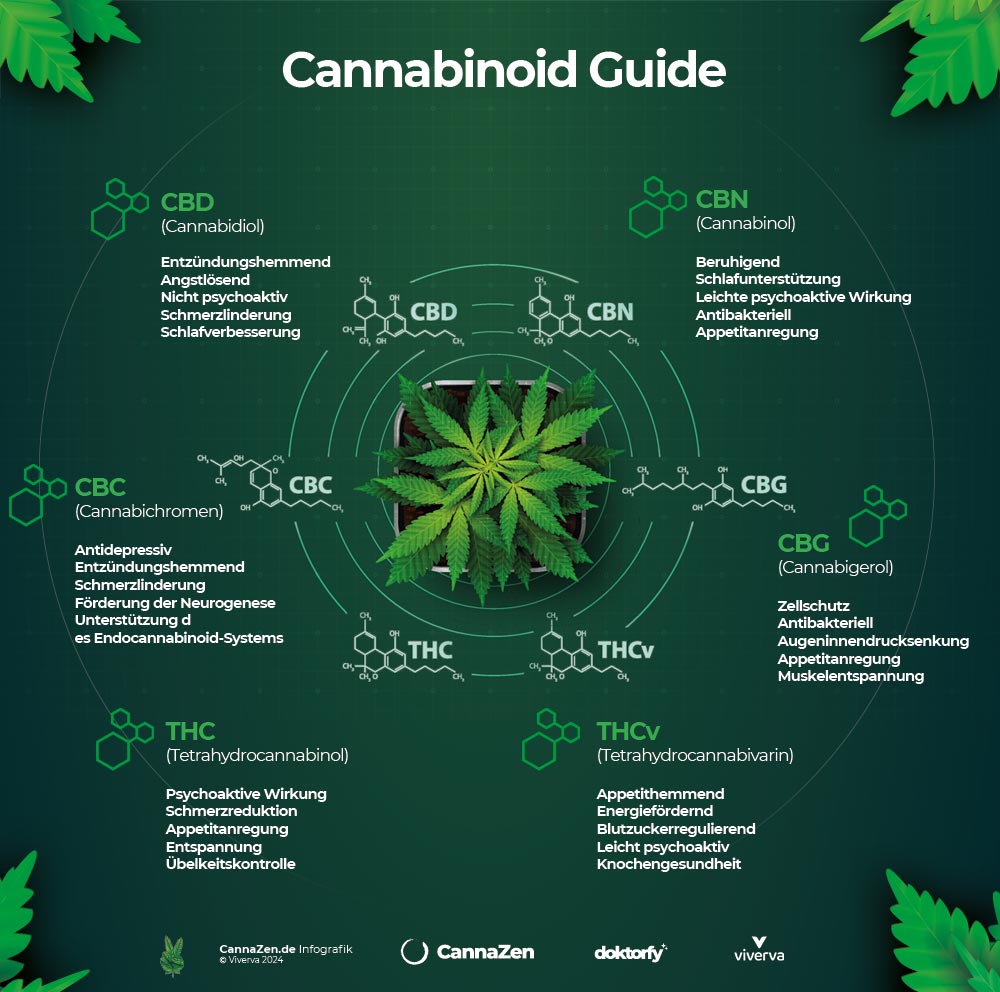
Infografik: Cannabinoide in Cannabis
Learn more about cannabinoids here.
- THC
(Δ9-tetrahydrocannabinol ): psychoactive, analgesic, muscle relaxant. - CBD (cannabidiol): non-psychoactive, anti-inflammatory, anxiolytic, antipsychotic.
CBG (cannabigerol): “mother cannabinoid”, has anti-inflammatory, antibacterial and neuroprotective effects.CBC (cannabichromene): synergistic with THC/CBD, anti-inflammatory.- …
Terpenes
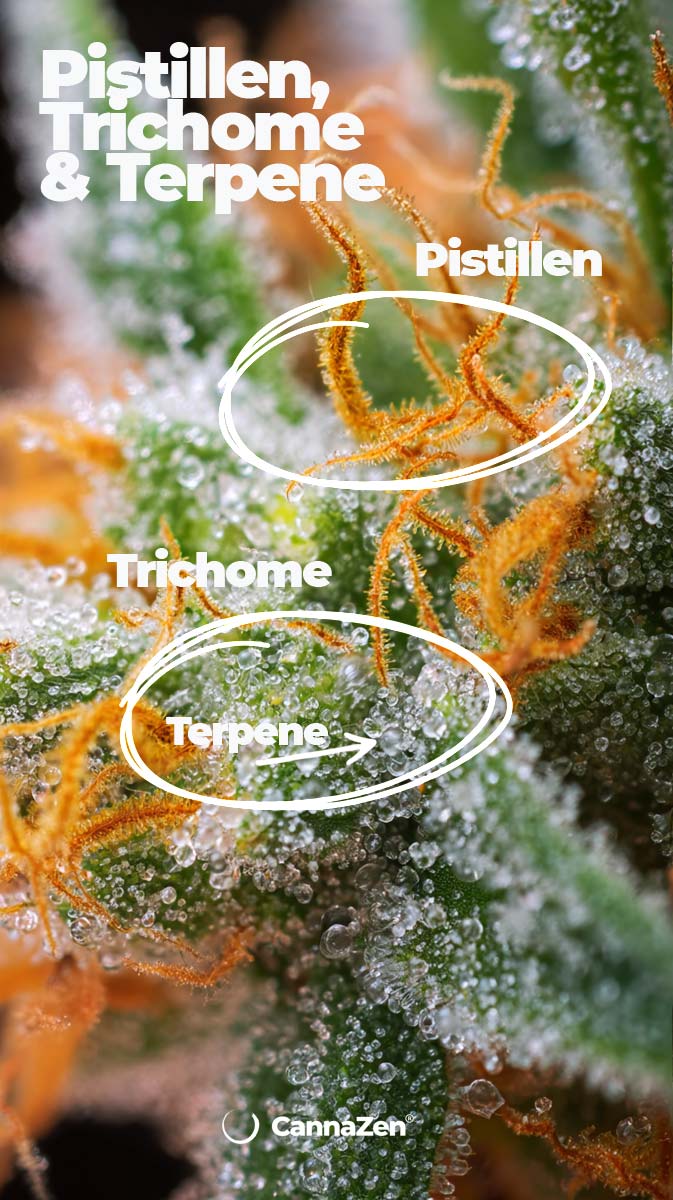
Infografik: Pistillen, Trichome und Terpene
Learn more about
β-Caryophyllene : the only terpene that binds directly to CB2 receptors → anti-inflammatory.Myrcene : sleep-inducing, muscle relaxant.Limonene : mood-enhancing, anxiolytic.Linalool : calming, muscle relaxant, sleep-inducing.Pinenes : promotes concentration, keeps you awake, dilates the bronchial tubes.Terpinolene : slightly activating, antioxidant.- …
Indication & effect: 5 examples
Medizinischer Einsatz erklärt
This table shows the indications for which certain cannabinoids and terpenes can be used in a targeted manner. Their combined effect influences pain, muscle tension, mood and neurological functions via the endocannabinoid system and the entourage effect.
As an example, let’s take a look at the 5 most common indications according to the German Hemp Association, which you know from the beginning (above). These cannabinoids and terpenes specifically help in the treatment:
| Disease | Important cannabinoids | Relevant terpenes | Main effects according to studies |
|---|---|---|---|
| Chronic pain | THC, CBD, CBG | β-Caryophyllene, myrcene, limonene | THC has analgesic and anti-inflammatory effects via CB1 receptors. CBD modulates inflammation and can enhance the opioid effect. β-Caryophyllene binds to CB2 and has strong anti-inflammatory effects. |
| THC, CBD, CBC | Linalool, β-caryophyllene, pinene | THC & CBD relieve spasticity (e.g. Nabiximols/Sativex). Terpenes such as linalool have a muscle-relaxing & anxiolytic effect. | |
| Tourette syndrome | THC, (partly CBG) | limonene, linalool | Studies show that THC can reduce tic frequency and severity. Terpenes can have a calming and anxiety-relieving effect. |
| Depression | CBD, CBG, low doses of THC | Limonene, linalool, β-caryophyllene | CBD modulates serotonin receptors (5-HT1A) and has an antidepressant effect. Limonene lifts the mood, linalool calms. |
| ADHD | CBD, low doses of THC, CBG | Pinenes, limonene, terpinolene | CBD has an anxiolytic effect, improves focus. Pinene promotes alertness & concentration, limonene lifts mood. Terpinolene can have an activating effect. |
What does science say?
Studienlage erklärt
In essence, the evidence for adults is strongest in three areas: chronic pain, MS-associated spasticity and chemotherapy-induced nausea/vomiting (CINV) despite standard therapy. Major reviews and guidelines see small to moderate, clinically relevant improvements here. There is evidence for other areas (e.g. sleep, anxiety, irritable bowel syndrome), but this is inconsistent and often only has weak to moderate certainty.
Sources: National Academies 2017, ACP/Annals 2025
Overall picture: Where does it help?
Chronic pain (especially neuropathic): Consistent, but rather small to moderate pain relief; as an add-on or option after failure of standard therapies.
Sources: ACP/Annals 2025, National Academies 2017
MS spasticity: Add-on with THC:CBD spray (nabiximols) significantly reduces spasticity scores in RCTs/meta-analyses.
Source: Azadvari 2024
Chemotherapy-induced nausea/vomiting (CINV): Additional improvement in refractory courses when cannabinoids are added to guideline-based antiemesis.
Sources: ASCO 2024, Cochrane 2015, Grimison 2024
How strong are the effects?
The average pain relief is usually small to moderate, but can be clinically significant for individual patient groups – realistic expectation instead of “panacea”. Spasticity reductions are detectable in validated scales (NRS, Ashworth). In CINV, the response rate improves in addition to standard therapy, but with more mild side effects.
Sources: ACP/Annals 2025, Azadvari 2024, ASCO 2024
Why does it work? Briefly explained
THC and CBD modulate the endocannabinoid system (CB1/CB2) and thus pain processing, muscle tone, nausea, appetite and inflammation. THC binds primarily to CB1 in the CNS, CBD influences inflammatory pathways and can modulate THC effects.
Source: National Academies 2017
Risks & security
Frequent, mostly mild side effects: Fatigue, dizziness, dry mouth, nausea; dose- and THC-dependent.
Source: ACP/Annals 2025
Psychological risks: Higher risk of psychotic symptoms, especially with high potency THC and frequent use; medical selection and monitoring are important.
Source: Argote 2023
Driving ability: Measurable driving impairment over several hours after inhalation; subjective self-assessment is unreliable.
Sources: JAMA Psychiatry 2022, Marcotte 2022
Practice: When does it make sense?
Medical cannabis is typically a second to third line option after insufficient benefit or intolerance of established therapies. Standardized extracts or oral sprays (e.g. THC:CBD for MS spasticity, CINV) are preferred, with structured follow-up after 4-12 weeks.
Sources: ACP/Annals 2025, ASCO 2024
Frameworks in Germany
Prescribable since 2017; available on “normal” (also e-)prescription since April 1, 2024. The indication applies to serious illnesses and after all standard therapies have been exhausted. Further details are provided by health insurance companies and authorities.
Sources: Barmer 2024/25, BfArM 2024, BfArM accompanying survey 2022
Conclusion: Medical use
For adults, medical cannabis has solid evidence for chronic pain, MS spasticity and refractory CINV. The effects are small to moderate on average, but can be significant for individual patients. The benefits and risks should be weighed up individually and closely monitored by a doctor.
Sources: National Academies 2017, ACP/Annals 2025
Prescription & order cannabis online
 Order online in 3 minutes
[zen_sorten_shop]
 4.7 / 5.0 stars(Google)
Thank you very much for your trust!