
Cannabis prescription health insurance – Are you wondering how the cost of cannabis is covered by health insurance? Many patients buy their medicinal cannabis with a private prescription as self-payers. If you want to get it through your health insurance, we’ll show you the 5 important steps clearly and simply – plus practical knowledge on applications, deadlines, rejections and your best course of action. Don’t miss our checklist for a strong application at the end.
Cannabis prescription health insurance? How it works
Typically, you order with a private prescription, which means you pay for it yourself (both the prescription and the flowers and extracts). However, as we often receive questions, here is a brief explanation of how the costs can be covered and what health insurance companies really look out for.
We received this question from the community today:
“Many people hope that their health insurance will cover the costs, as otherwise they won’t be able to afford it. What is it like for those who need cannabis for medical reasons?”
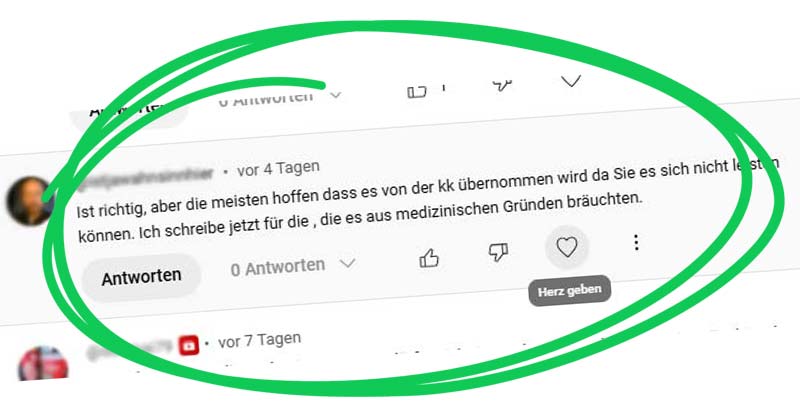
CannaZen YouTube: Hausarzt Video Rückfrage
Having the costs of cannabis covered by your health insurance can save you several hundred euros a month. However, the process is strictly regulated and requires a clear medical justification. Here we explain which requirements you need to meet and how you can increase your chances of success with a strong application. We also show you the typical mistakes that often lead to rejections when submitting applications. This will help you to better assess whether an application makes sense for you.
Let’s start with step 1:
Medical diagnosis – Step 1

Cannabisärztin erklärt Extrakt.
The first step is to visit a doctor (often called a cannabis doctor ) who is familiar with cannabis therapies – online or on site. The doctor checks whether there is a serious illness and whether standard therapies are unavailable, unsuitable or unreasonable. This is the basic requirement according to Section 31 (6) SGB V.
- Choose a doctor
- Clarify diagnosis
- Check reasonableness
Private prescription or health insurance?
Many start via telemedicine to get started quickly. At the same time, you can clarify at an early stage whether health insurance coverage is realistic. Important: You don’t have to be “out of therapy”. The decisive factor is a comprehensible medical justification as to why guideline procedures are not (or no longer) effective or are not reasonable.
- Quick start
- Check cash register opportunity
- Justification counts
Receive recipe – Step 2
If the doctor determines that cannabis is medically useful, you will receive a prescription.
Here you can see a private prescription that you receive, for example, when you order your cannabis prescription online. A private prescription looks almost identical – the difference is the cost coverage.
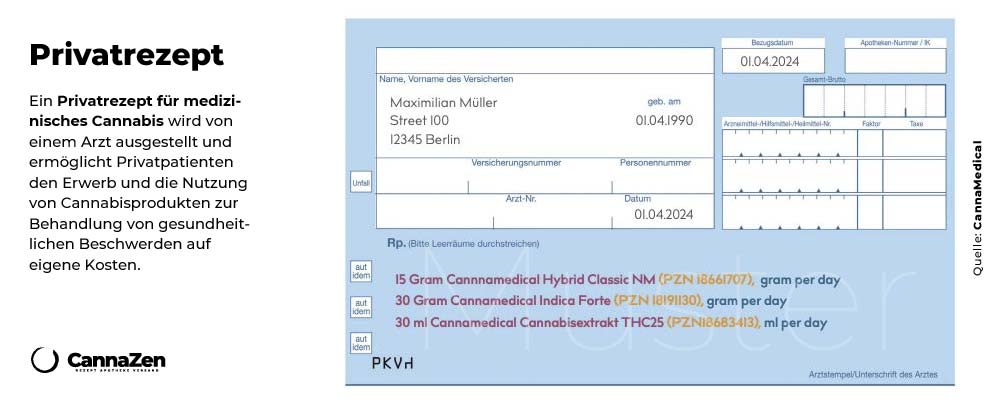
Beispiel: Cannabisrezept Selbstzahler
Application to the health insurance company – step 3
The prescription alone is not enough for the insurance company. A detailed medical justification (MD questionnaire) is required. In it: diagnosis(es), symptoms, treatment goal, previous therapies with effects/side effects, reasons against further standard therapies and the prognosis that cannabis can noticeably improve the symptoms. References to guidelines and studies are useful – lower levels of evidence (e.g. case series) are also sufficient if higher levels are not available, provided the justification is comprehensible.
- MD form
- Bundle findings
- Present forecast
Here are two helpful links with a good explanation of the process:
Practical tip for your application

einfach erklärt
Enclose your own, legible patient history (everyday life, work, sleep, participation, pain history). Include doctor’s letters, rehab/hospital findings, imaging and a pain diary. It is better to have too many documents than too few. Make sure that the forms are complete and digitally legible.
- Enclose patient history
- Attach documents such as doctor’s letters
- Digitally readable
Awaiting approval – Step 4
 The health insurance fund usually has two weeks (four weeks if the Medical Service is involved). A decision within three days may be necessary for inpatients. A rejection (tip! We will tell you how to deal with this later) is only permitted in justified exceptional cases – the decisive factor is that the medical assessment is complete, plausible and comprehensibly documented.
Oh yes, and if your application is rejected, you can lodge an appeal or submit a new, improved application.
- 2-4 weeks waiting time
- Only exceptional rejection
- Objection? Submit a new one!
Economy & choice of mold
The doctor must observe the principle of cost-effectiveness. If suitability is likely to be the same, cheaper options (e.g. dronabinol, Sativex or standardized extracts) can be prioritized. Switching between flowers/extracts or adjusting the dose is generally possible without a new basic application as soon as the treatment has been approved.
- Check costs
- Favorable prioritization
- Change possible
If you are wondering what Dronabinol & Co are, here is a brief explanation.
- Dronabinol → Pure THC(Δ9-tetrahydrocannabinol) in oily drops or capsules.
- Sativex → Oral spray, mixture of THC and CBD in a ratio of approx. 1:1.
- Standardized extracts → Depending on the recipe, THC or mixtures of THC and CBD
Obtaining medicinal cannabis – Step 5
With a permit, you can pick up your medicinal cannabis from a pharmacy (often called a cannabis pharmacy ) or order it online via certified platforms. Pay attention to the prescription (product/dosage, daily/monthly quantity) and the documentation of your effect and tolerance.
It’s that simple! How to get the costs covered by your health insurance.
Cannabis pharmacy near you? Take a look at our cannabis map.

More tips? More facts on cost coverage
The processes are extensive and vary in strictness depending on the health insurance company. The success rate and depth of examination vary, which is why it is worth keeping proper documentation. The highest courts have clarified that health insurance funds and courts primarily check the completeness and plausibility of the medical justification; detailed medical decisions are primarily the responsibility of the panel doctor. It is not necessary that you are “out of therapy” – the decisive factor is a comprehensible consideration of standard procedures and their reasonableness.
Here are the 3 key points again:
- Documentary counts
- Doctor decides
- Not out of therapy
Lecture: Assumption of costs
Here is a video tip if you want to take a closer look at the topic of cost coverage:
Deadlines, Palliative & Clinic
Standard periods are two weeks (with MD: four weeks). Specialized outpatient palliative care (SAPV) does not require a separate cannabis permit. A very quick decision (three days) can be obtained in hospital if treatment is started there.
- Regular (process above): 2-4 weeks
- SAPV: free
- Clinic: 3 days
Rejection: What to do?
Typical reasons are “not fully treated”, “incomplete formalities” or “insufficient evidence”. Respond with additions (findings, course, studies), file an objection or submit a new application. Social courts have repeatedly ruled in favor of patients if the justification was complete.
Cancel? Stay tuned!
- Submit later
- Contradict
- Reposition
Protection for doctors
Even if pre-authorization is not always necessary, a voluntary cost coverage check with the health insurance company can be useful (especially in borderline cases). Positive feedback significantly reduces the risk of recourse (reclaims by the health insurance company), especially in the case of MD reports (reports by the Medical Service).
- Voluntary testing
- Use MD
- Reduce recourse

So, let’s summarize everything once again:
Checklist for a strong application
This will significantly increase your chances:
1. complete medical justification
Diagnosis(s), symptoms, treatment goal, previous therapies with effects/side effects, reasons against further standard therapies (e.g. intolerance, contraindications, unreasonableness) and a prognosis with realistic benefits.
- Diagnosis
- Course
- Forecast
2. enclose your own patient history
Everyday life, work, sleep, social participation, pain scales (0-10), progression over weeks/months; preferably with pain diary.
- Everyday life
- Scales
- Diary
3. supporting documents & guidelines
Doctor’s letters, rehab/clinic reports, imaging; specialist guidelines and studies. Lower evidence levels are possible if clearly justified.
- Findings
- Guidelines
- Studies
4 Formalities & deadlines
Fill in all fields digitally and legibly, bundle documents as a PDF, monitor deadlines, rectify or resubmit quickly if rejected.
- Bundle PDF
- Meet deadlines
- Set up again
Applying to the health insurance fund: what you need to know
What should you remember for your application to the health insurance company? A prescription and a detailed medical justification are required for the health insurance company to cover the costs of cannabis. The application must include the diagnosis, symptoms, course of treatment and prognosis so that the insurance company can review it.
The health insurance company normally decides within 2 weeks, with MD reports it can take up to 4 weeks. A rejection is only permitted in exceptional cases, and you can appeal or reapply at any time. Doctors must observe the principle of cost-effectiveness and often prefer cheaper THC preparations such as dronabinol, Sativex or extracts.
Clean, complete documentation and a well-founded medical assessment significantly increase the chances of success.
Here’s the reason for this guide! Don’t miss a video, follow us on YouTube.